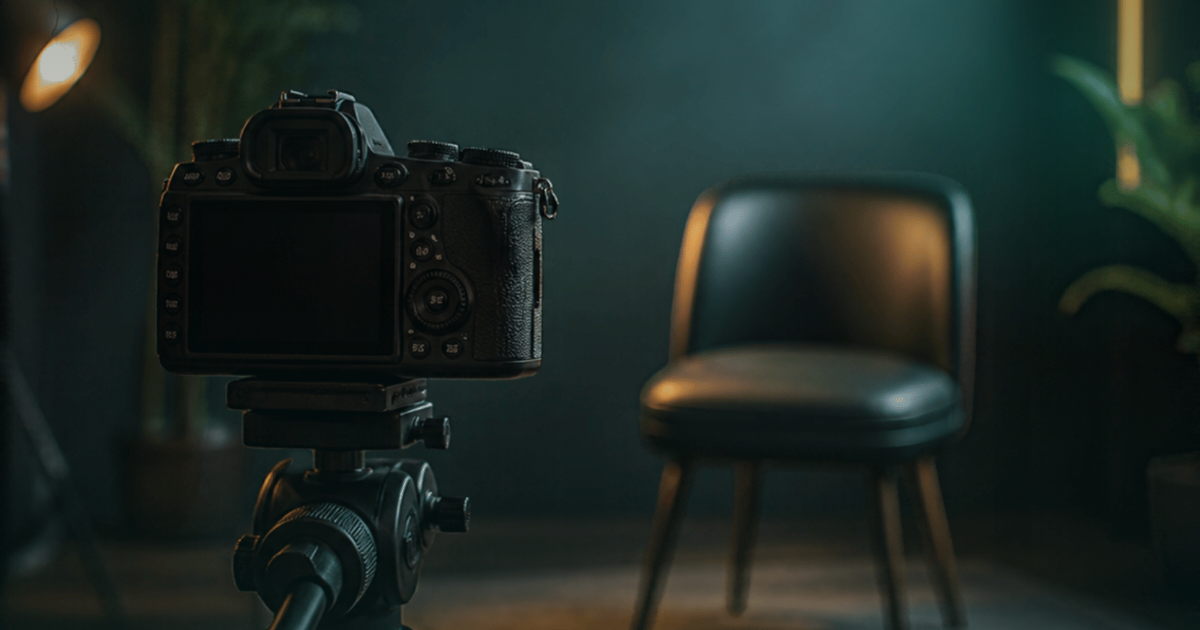
Most people set the camera down wherever it happens to sit, and then wonder why they don't like how they look.
It usually isn't your face. It's the angle, the distance, and about four inches of empty space above your head.
The good news: camera angles for talking head video come down to three decisions, you make them once, and then your setup is just your setup. No judgement required after that.
Camera angles for talking head video start at eye level
This is the one that changes the most.
If the camera sits below you — propped on a desk, leaning against a laptop — you're looking down into it. That angle does unflattering things to almost everyone, and more importantly it reads as distance. The viewer is literally being looked down on.
Too far above and you get the other problem: you're peering up, which reads as small.
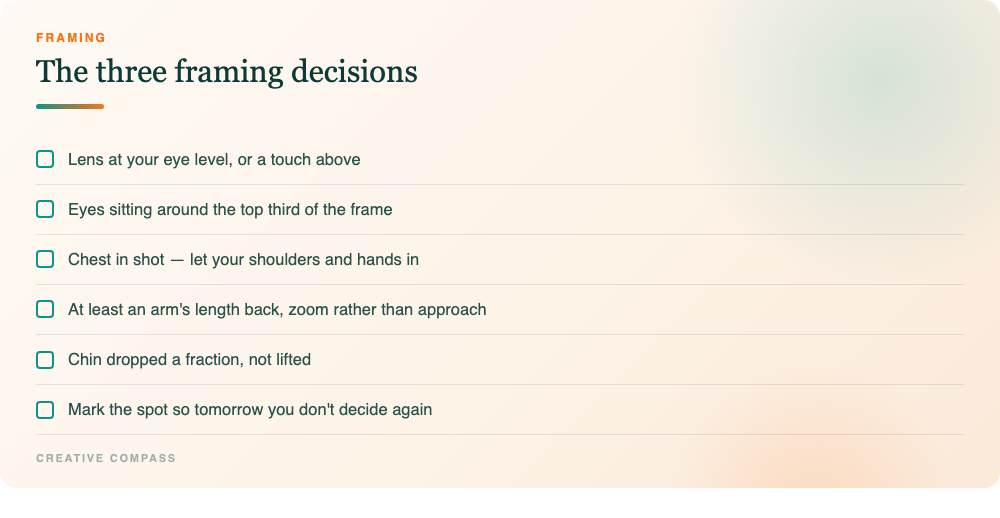
What you want is the lens at your natural eye level, or very slightly above. Slightly above softens your features, keeps shadows from pooling under your eyes, and opens the whole frame up. It's the position I set first on every shoot, before lighting, before anything.
Practically: get the phone or camera up. Books under the tripod, a shelf, a proper stand — it doesn't matter how. If you film at a desk, the laptop-clip mount is the cheap fix that works, because it puts the lens where your eyeline already is.
Fix your headroom, then stop thinking about it
Headroom is the gap between the top of your head and the top of the frame.
Too much and you look like you're sinking out of shot, with a large uninteresting ceiling doing nothing. Too little and you're cropped at the forehead, which feels claustrophobic.
What you're aiming for is a small gap above your head, and your eyes sitting around the top third of the screen. That eye position is the thing to actually remember — if the eyes land there, the headroom usually takes care of itself.
The related mistake is sitting too close. When the camera is right on your face, you lose the energy of your body — your shoulders, your hands, the way you move when you're talking. All of that is carrying your meaning, and cropping it out flattens you.
So zoom out. Show your chest. Let your shoulders into the frame and let yourself gesture. People connect to the whole person, not a head.
The chin thing nobody mentions
Here's a detail from reviewing a lot of people's footage.
If your chin is lifted and you're looking down into the lens, it creates a subtle tension. Nobody watching could name it. They feel it as distance, or slight coldness, or something a bit off that they can't place.
Drop the chin a fraction so you're looking straight into the lens rather than down your nose at it. It's a tiny adjustment and it changes the temperature of the whole video.
This is the kind of thing that separates footage that feels warm from footage that technically has nothing wrong with it. Your audience will never consciously notice. They absolutely feel it.
How close is too close
Distance does something to your face that most people blame on their face.
Phone lenses are wide. Wide lenses exaggerate whatever is nearest the camera, which when you're close is your nose and forehead. Everything further back — your ears, the sides of your face — falls away faster than it should. The result reads as slightly distorted, and almost everyone interprets that as I look wrong rather than I'm too close to a wide lens.
Back up and the problem disappears. At arm's length and beyond, the proportions settle. If you need a tighter shot, back the camera up and zoom in slightly rather than bringing it closer — you get the same framing without the distortion.
This is why the same person can look completely different in a selfie and in a photo taken from across a room, with no change in lighting. It was never the face.
A practical floor: keep the lens at least an arm's length away. Further is usually better, and if that makes you small in frame, zoom rather than approach.
What's behind you matters more than you think
Your background is doing one of two things: supporting you, or quietly competing with you.
You don't need a studio. You need intentional. One question before you hit record: is anything in this frame pulling the eye away from my face?
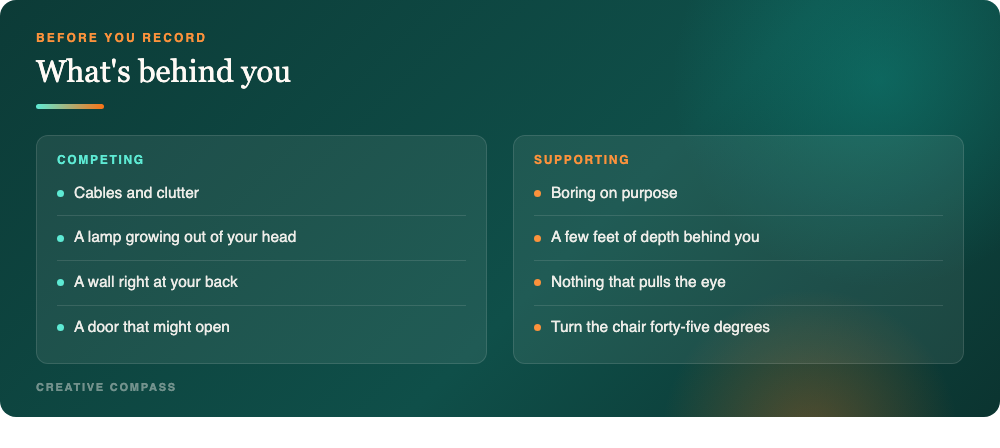
Usual offenders: cables, a half-empty mug, laundry in the corner, a door that looks like it might open, a lamp growing out of your head. Depth helps — a background a few feet behind you looks considerably better than a wall right at your back, because the separation gives the shot dimension.
Take ten seconds to look at the frame before you look at yourself in it. Most background problems are solved by turning the chair forty-five degrees.
Standing changes more than you'd think
Worth testing even if you've always filmed seated.
Standing opens your chest and changes your breathing, which changes your voice — more support, more range, less of the slightly compressed sound people get when they're folded into a chair. Some people become noticeably more themselves on their feet.
It also changes what your hands do. Seated, hands tend to stay in your lap or grip something. Standing, they move with what you're saying, and that movement carries meaning for the viewer.
The framing rules don't change: lens at eye level — which now means considerably higher, so you'll need a proper stand — and far enough back that you're not cropped at the chest. The common mistake is standing up and leaving the camera where it was, so now you're filming your chin from below.
Try one video each way and watch both back on mute. You'll see the difference in your shoulders before you hear it in your voice.
If you move around while you talk
Everything above assumes you're seated and static, which most talking-head video is.
If you're a walker — and some people simply think better on their feet — a handheld gimbal camera is the thing that makes it watchable. I use a pocket gimbal for walk-and-talks because the stabilisation does what your hand can't, and it's small enough that you'll actually bring it.
Same rules apply. Lens at eye level, don't crowd yourself, watch what's behind you. Walking just means checking them while moving.
Vertical needs its own decision
If you're cutting shorts from the same footage, decide now rather than in the edit.
A horizontal frame that's correctly composed almost never crops to a good vertical. Your eyes end up too high, your head gets clipped, or you're floating in the middle of a tall empty rectangle. The crop has to come from somewhere and it's usually from your shoulders.
Two workable approaches. Frame a little wider than you want horizontally, leaving room on both sides so a 9:16 crop can take the middle without losing you — you accept a slightly loose wide shot to get a good vertical. Or film the shorts separately, standing closer, framed vertically from the start.
The second gives better results and takes an extra ten minutes. The first is free. What doesn't work is composing tightly for horizontal and hoping.
Set it once, then leave it alone
Here's the part that matters more than any individual rule.
The reason framing feels hard is that most people re-decide it every single time they film. Camera somewhere new, different chair, different distance, a fresh round of judging how you look before you've said a word — and that's exhausting in a way that has nothing to do with being on camera.
So do it once. Properly. Get the lens to eye level, set your distance so your chest is in shot, check what's behind you, and then mark it. Tape on the floor where the tripod legs go. A note of the shelf height. Whatever means tomorrow you sit down and it's already right.
Decisions you've made once stop costing you. That's most of what a good setup actually is.
Do this today
Lens at eye level. Eyes in the top third. Chest in frame, chin dropped a fraction. Turn the chair until the background is boring.
Then film the thing — and tomorrow, don't decide any of it again.