I've been behind a camera for twenty years. Feature sets, commercials, music videos, the works.
And I still felt sick the first time I turned one on myself.
Not because I didn't know what I was doing. I knew exactly what I was doing. I could tell you which lens to grab, how to set your key light, what to say when you're stalling for time between takes.
That was the problem.
I knew how it was supposed to look — a full crew, a colourist, an editor, a schedule board pinned to a wall. And when I looked at my little tripod in my living room, at 6:47am, with no one else there, I couldn't quite believe that what I was about to do counted.
If you're a coach thinking about YouTube — or you've already started and you've quietly stopped — this post is for you. Because the reason you're not growing isn't the algorithm. It's not your face. It's not that "coaches don't work on YouTube."
It's that most of what you've been taught about YouTube assumes a version of it that requires a team you don't have.
Here's the actual system for growing on YouTube as a solo coach. It's what I use. It's what works.
What "growing on YouTube" actually means for a coach
Let me reframe this before we go any further.
If you're a Beast-tier creator, growth means millions of views on individual videos. If you're a coach, growth means the right hundred people find you — and a percentage of them become clients.
Those are two completely different games. You don't need one million people. You need the specific people who type "how do I get over camera nerves" or "how to structure a coaching offer" or whatever your niche is — and you need them to land on your video.
This is a good problem. The number is small. Your videos don't need to go viral. They need to rank — for the exact search a would-be client is already typing.
If your first video ranks for "how to journal for anxiety" and gets 400 views a month from that search, and 2% of those people book a free call, that's eight qualified calls a month from one video you filmed once.
That is what growing on YouTube looks like when you're a coach. Not viral. Ranked.
The reason you keep stopping
Here's what I see, over and over, in the workshops I run.
Coach gets excited. Watches five YouTube-growth tutorials. Buys a mic. Buys a light. Rearranges her office. Writes a script. Films for four hours on a Saturday. Sits down Sunday morning to edit. Realises she has no idea how to edit. Goes down a rabbit hole watching editing tutorials. Loses the whole weekend.
Never uploads.
Or — she uploads. It gets 34 views. She tells herself she'll do the next one "when things calm down." Things do not calm down. Six months later she hasn't touched the camera.
The system broke, not the person. Every step of what I just described was optional. She didn't need to write a script. She didn't need to edit. She didn't need the light or the mic. The one thing she needed — the thing nobody teaches — is a sustainable rhythm of showing up in front of the camera.
"Elfina changed my dread into fresh desire and doable first steps for video content." — Lisa Ann, Community Member
The four things that actually matter (and the seven that don't)
Let me be direct.
These four things move the needle for a coach on YouTube:
- You film consistently. Weekly, ideally. Whatever cadence you can keep, without breaks.
- You speak to a real person. Not to "an audience." Not to "the camera." To one specific person you're trying to help.
- You answer questions people are already searching for. The title and the first thirty seconds are the whole SEO game.
- You get out of your own way. No re-recording. No script. No perfectionism. Real, first-take-y, and shipped.
Here is what does not matter (yet):
- Ring lights (window light is better)
- A separate microphone (your phone is fine to start)
- B-roll (nobody cares about the b-roll on a 400-view coaching video)
- Title cards, music, fancy edits (skip)
- Uploading on a specific day-of-week (helpful eventually, doesn't matter early)
Every one of those things adds a step between you and hitting publish. Every step is a place where you'll stop.
The one system I've never seen a coach outgrow
This is the whole thing.
Film four videos in one session, every four weeks. Post one per week. Repeat forever.
That's it.
One filming afternoon a month. Four videos on the tripod. You come to it with four topics — real questions your ideal client has asked you — and you talk to camera for three to five minutes about each one. No script. No re-records.
Then, over the next four weeks, you post one a week. One session × 12 months = 48 videos a year. Roughly one video per week for a full year, from one afternoon a month.
Nobody who does this stops growing on YouTube.
The reason it works isn't the number. It's that you never have to think about content between filming days. Your energy goes into filming well, not into the anxiety of "am I going to film today?"
How to actually spot a topic worth filming
I know — "just film four videos a month" sounds easy until you're staring at your ceiling on filming morning wondering what to say.
You don't need topics. You need questions. Specifically: questions the exact person you're trying to help is already asking.
Start with what your clients ask you all the time. Every question you've already answered a dozen times over is a video waiting to be filmed. Add to that: any question you wish more people in your field were asking. Between the two, you'll have twelve prompts before lunch.
The best topic to film is a question someone is already trying to answer for themselves — that you already know the answer to. If you had to explain it to a client sitting across from you at a coffee shop, you could do it in three minutes without notes. Film that.
What to actually say when the camera is on
This is where most coaches freeze. Here's the trick I teach in every workshop:
Talk to one person you love. Not to the camera. Not to "your audience." To one specific person. Your best friend. Your sister. A client you loved working with.
Imagine they just texted you the question. Answer them.
The lens becomes a person. Your voice softens. What comes out is you, being useful to someone specific. Google is measuring watch time — how long people stay on your video before leaving. When you sound like you're talking to a specific human, other humans stay.
The mistake that keeps most coaches at 34 views
Almost every coach I've worked with has made this exact mistake: they optimise for the wrong thing.
They obsess over the thumbnail, the intro, the video's opening thirty seconds — but they haven't picked a topic anyone is searching for.
Do the searching first. Then film.
Your first month, honestly
- Day 1 — Write down eight questions your clients ask you all the time.
- Day 2 — Pick the four you feel most alive to answer.
- Day 3 — Set up your phone on a tripod in front of a window. Film the four. Don't re-record. Don't edit.
- Day 4 — Upload the first one. Use the exact question as your title.
- Day 5 — Do nothing. Don't check the views.
- Weeks 2–4 — Upload the next three, one per week.
- End of month 1 — Four videos live, ranked for four real searches. The algorithm has data now.
Where Creative Compass fits (if you want the system built for you)
Everything I just described is the system Creative Compass runs.
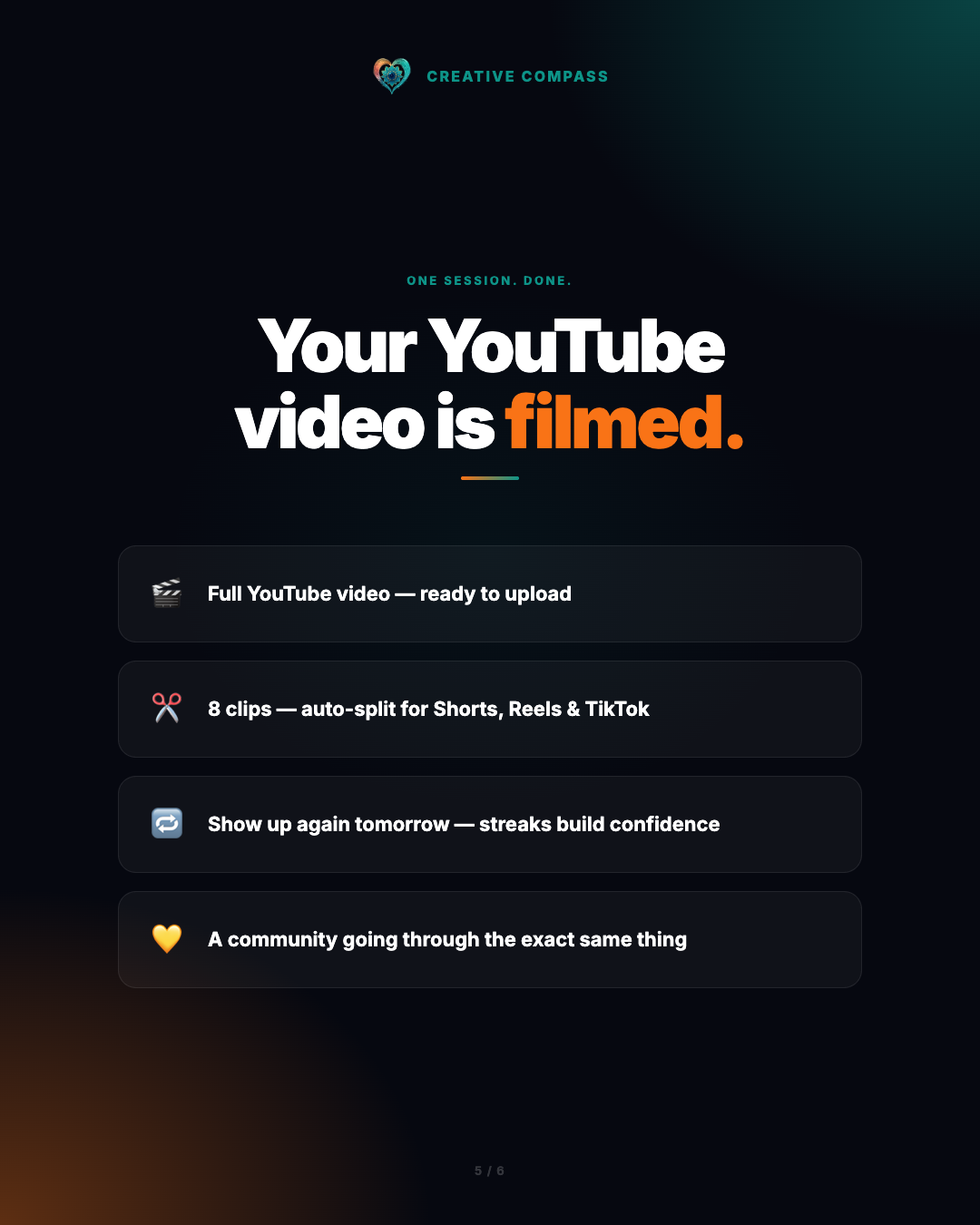
You open the app. It gives you your customised session — prompts pulled from your niche, your audience, and the real questions your ideal client is searching for. You film to those prompts, one after another, in a single session on your phone. When you're done, the app splits the whole session into short-form clips automatically.
If you've been trying to grow on YouTube and keep stalling out on the "what to film" part, this is what fixes it. It's the tool I built after twenty years on set, for the exact coach I used to be — the one who knew how to film everything except herself.