Watch almost anyone's first take and you'll see the same thing: about ten seconds of throat-clearing before the video actually starts.
"Hi guys, so, um, welcome back — today I wanted to talk about something that's been on my mind a lot lately, and I think it's something a lot of you might be dealing with too, so…"
Nothing has happened yet. Thirty words in and the viewer still doesn't know what they're watching.
The fix isn't more charisma. It's structural, it takes about four minutes, and once you know how to script a video intro you stop re-solving it every time you film.
Script the first thirty seconds. Improvise the rest.
Let's get the big decision out of the way, because it's the one that causes the most wasted effort.
Don't script the whole video. Fully scripted talking-head footage almost always reads as recited — your eyes go flat as you retrieve the next line, your rhythm flattens, and viewers feel it even when they couldn't tell you why. Scripting the lot also means a single fumbled sentence sends you back to the top.
Don't wing the opening either. The first thirty seconds are where you're least warmed up and most self-conscious. That's exactly where improvisation falls apart.
So: script the opening tightly, bullet the rest. Four or five bullets for the body is plenty — you know your material, you just need the order. The opening gets written word for word because it's the part you'll stumble on and the part that decides whether anyone stays.
On set we do a version of this constantly. The scene is blocked precisely, but the actor is still allowed to breathe inside it. Structure at the edges, freedom in the middle.
Cut your first ten seconds
Here's the single most useful thing in this post.
Film your intro the way you naturally would. Then watch it back and delete everything before the first real sentence.
Almost always, the first eight to twelve seconds are warm-up — a greeting, an apology, a throat-clear, a slow wind-up to the actual point. They felt necessary while you were recording because you were getting your nerve up. They're doing nothing for the person watching.
What's left after the cut is usually a much better opening than anything you'd have written in advance.
This is also why your intro feels awkward when you script it cold: you're writing down the warm-up. You're transcribing the nervous part and then performing it deliberately, which makes it worse rather than better.
If you'd rather not film to find it, there's a shortcut. Write your intro, then cross out the first two sentences and read what's left. If it still makes sense, those sentences were warm-up. They nearly always are.
Open on the moment, not on yourself
Most intros start with the speaker. Better ones start with the viewer.
Compare these.
"Hi, I'm Elfina, I'm a filmmaker and confidence coach, and today I want to talk about scripting."
"You've written the intro four times and it still sounds like a voiceover."
The first one asks for patience before it offers anything. The second one puts the viewer in a situation they recognise — and now they want to know what you're going to do about it.
Name the moment your person is standing in. Not the topic in the abstract, the specific moment: the fourth rewrite, the take you deleted, the recording you didn't post. Specific beats general every time, because specific is what people recognise themselves in.
Then you can say who you are. It lands completely differently once they want to know.
The three-part intro that works for almost anything
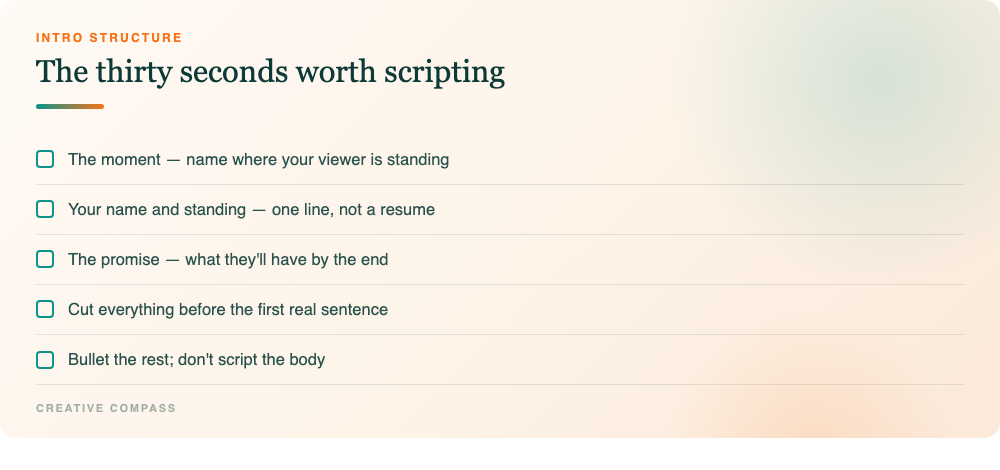
When you need a structure to hang it on, use this one. It's about thirty seconds spoken.
One — the moment. One sentence naming where the viewer is. "You've rewritten this intro four times and it still sounds like a voiceover."
Two — your name and your standing. One sentence, said plainly. Not a résumé. "I'm Elfina — I've spent twenty years on film sets watching takes get thrown away."
Three — the promise. One sentence on what they'll have by the end. "Here's the structure I use, and why most intros fall apart in the first ten seconds."
That's it. Three sentences, roughly fifty words, and the video has properly begun.
The mistake to avoid is inflating part two. Your credentials are the least interesting thing in the opening — they're the reason to trust the promise, not the reason to watch. One line.
Say it before you write it
Written language and spoken language are different languages, and scripting pulls you toward the written one without asking.
So reverse the order. Say the intro out loud first, as if to one person, then write down what came out. You'll naturally use shorter sentences, plainer words, and contractions. "I'm going to show you" instead of "In this video I will be demonstrating."
Then read it back aloud. Anything you trip over, change — a stumble is almost never your fault, it's a sentence built for the page. If it doesn't sound like you across a kitchen table, it won't sound like you on camera.
Words to cut on sight
A short list, from watching a lot of footage.
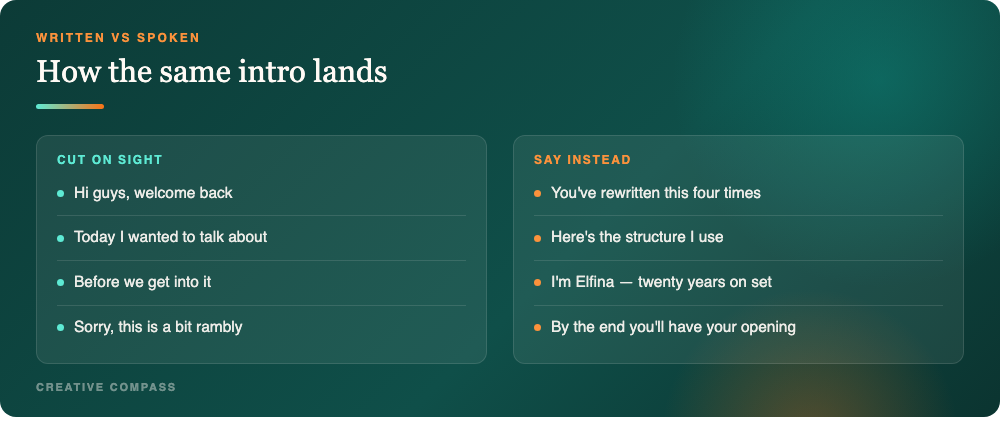
- "Hi guys, welcome back to my channel." Says nothing, and tells new viewers they've missed something.
- "Today I wanted to talk about…" Announcing the topic instead of starting it. Just start.
- "Before we get into it…" You're already into it. Whatever follows belongs later or nowhere.
- "Sorry, this is a bit rambly." Never apologise in an intro. You're training the viewer to expect less.
- "So, yeah…" The sound of a sentence ending without landing. Cut it and let the silence sit.
What to keep instead: the specific thing. "Four rewrites" beats "struggling with intros". Detail is what makes people feel known.
A hook and an intro aren't the same thing
Worth separating these, because conflating them is why a lot of intros bloat.
The hook is the first sentence. Its only job is to stop the scroll — it earns you the next five seconds and nothing more. On short-form it's often the entire opening.
The intro is the next twenty-five. Its job is orientation: who's talking, what this is, why stay.
Short-form usually wants hook only — get in, make the point, get out. Long-form wants both, in that order. The mistake is writing a long-form intro and then bolting a hook on top, which gives you fifty seconds of preamble and a viewer who left at twelve.
If you're filming both from one idea, write the hook once and use it for both. Then decide whether the video is long enough to earn an intro after it. Under two minutes, usually not.
One more thing people get wrong here: the hook does not have to be clever. "Your mic is in the wrong place" stops the right person instantly. Trying to be clever is what produces the fourth rewrite.
Why the awkwardness goes away
Worth naming the real reason this works, because it isn't about the words.
An intro feels awkward when you're doing two things at once — delivering the line, and monitoring how you're coming across. That split attention is what shows on your face. It's the same tell as someone reciting a speech while watching the room.
A scripted thirty seconds removes one of those jobs. You're not composing and performing simultaneously; the composing is done. All you have to do is mean it.
That's why actors can say the same words for the four hundredth time and still sound like they just thought of them. The words were never the hard part. Not having to invent them is what frees you up to actually be present.
And once the opening is solved, it stays solved. Same three-part shape next time, different specifics. You stop paying the awkwardness tax on every single video.
Do this today
Pick a video you've been meaning to film.
Say the intro out loud, once, to nobody. Write down what came out. Cross out the first two sentences. Check what's left has the three parts — moment, name, promise — and that part two is one line, not four.
Then film it, and cut anything before the first real sentence.
You'll get about ten seconds back, and the video will start where it should have started.